
Most B2B visitors do not introduce themselves the first time they land on a website. They read service pages, compare solutions, return to pricing, explore integrations, and sometimes leave without ever completing a form.
That does not make the visit worthless.
Anonymous traffic can reveal useful patterns long before somebody becomes a known lead. The challenge is understanding which activity represents genuine commercial interest and which activity is simply casual browsing.
Modern revenue teams are becoming better at making that distinction. Instead of treating every visitor as either a lead or a meaningless session, they combine website behavior, account fit, engagement, intent signals, and timing to understand which companies may deserve more attention.
The goal is not to identify and contact everyone.
It is to recognize stronger buying patterns, protect privacy, and create a useful path from website activity to marketing or sales action.
When that process works, anonymous traffic becomes part of a much larger revenue intelligence strategy.
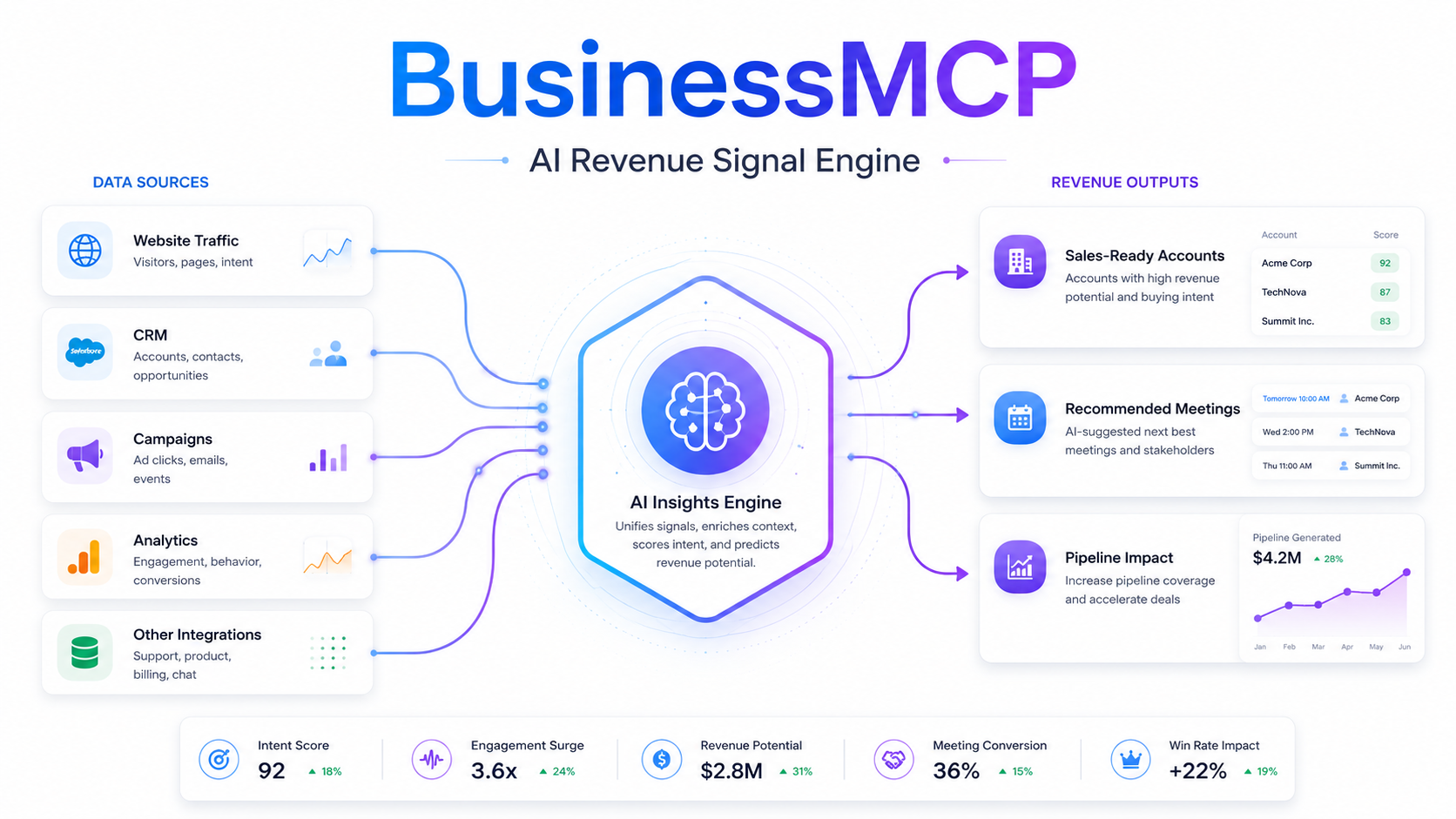
Why Anonymous Traffic Matters
B2B buying journeys often begin privately.
A potential customer may discover your company through organic search, an advertisement, a LinkedIn post, a partner referral, or an industry article. They may spend several minutes exploring the website and leave without doing anything that identifies them.
Days later, the same account may return.
This time they might look at product features.
Later they may check integrations, read a customer story, or visit pricing.
Traditional lead-generation reporting often sees these visits as separate anonymous sessions until somebody eventually fills out a form.
That leaves a gap.
Revenue teams can see conversions, but they often miss much of the research that happens before those conversions.
Anonymous visitor intelligence helps fill that gap by asking better questions:
- Which accounts appear to be returning?
- Which pages are attracting deeper interest?
- Are target companies researching commercial content?
- Which campaigns bring visitors that later return?
- How close is an account to the ideal customer profile?
- Is engagement becoming stronger over time?
These questions are far more useful than simply asking how many visitors reached the site.
Anonymous Does Not Mean Sales-Ready
Anonymous traffic can be valuable without automatically becoming a sales lead.
A visitor might be a future buyer, but they could also be an existing customer, partner, competitor, employee candidate, researcher, student, or automated bot.
That is why context matters.
One pageview rarely tells you much.
A stronger pattern might include a good-fit company visiting repeatedly, reading solution pages, exploring integrations, viewing case studies, and eventually reaching pricing.
This type of journey deserves more attention because several signals reinforce one another.
Revenue teams should evaluate anonymous activity through four basic dimensions.
Account Fit
Does the company resemble your ideal customer?
Consider industry, size, geography, business model, technology environment, and target-account status.
Behavior
What did the visitor actually do?
Commercial pages usually deserve more weight than general educational content.
Recency
Did the activity happen yesterday or six months ago?
Fresh intent is normally more actionable.
Frequency
Has the account returned several times?
Repeated activity can indicate deeper research.
Combining these factors gives marketing and sales a more reliable basis for deciding which accounts deserve attention.
How Website Visitor Intelligence Works
Visitor intelligence starts with website behavior.
Depending on the technology being used, analytics may capture events such as:
- Landing pages
- Referral sources
- Pageviews
- Return sessions
- Product interactions
- Downloads
- Form starts
- Campaign activity
- Session depth
- Conversion events
This information can be useful even when the visitor remains anonymous.
A second layer may attempt to associate some traffic with a company or account.
For B2B teams, that company-level context can significantly improve the usefulness of website analytics.
Knowing that somebody viewed pricing is one thing.
Knowing that repeated pricing activity may be associated with a target account is far more meaningful.
However, company-level recognition should never be confused with personal identity.
An account match does not automatically tell you which employee visited, whether that individual controls the budget, or whether they want to hear from sales.
Good visitor intelligence adds context without pretending to know more than the available data supports.
Turn Behavior Into Intent Signals
Behavior becomes useful when events are interpreted together.
Imagine two companies.
Company A visits one educational article and leaves after two minutes.
Company B visits five times over two weeks. It opens solution pages, reads two case studies, looks at integrations, and reaches pricing twice.
Company B is clearly producing a stronger pattern.
Useful intent signals can include:
- Repeated visits
- Pricing research
- Product-page engagement
- Integration pages
- Implementation guides
- Comparison content
- Case studies
- Security pages
- Documentation
- Demo activity
- Downloads
- Form starts
None of these should be viewed as absolute proof that a purchase is about to happen.
Intent signals indicate research.
They become more powerful when combined with account fit and timing.
See More Than Pageviews
BusinessMCP helps revenue teams connect anonymous website activity with account context, intent, and a clearer path toward qualified pipeline.
Explore BusinessMCP
Create a Qualification Model That Makes Sense
Visitor qualification does not need to become a complicated scoring project.
A straightforward system can often produce better adoption because marketing and sales can understand why each account is being prioritized.
A basic model could look like this:
| Signal | Priority |
|---|---|
| Strong ICP match | High |
| Pricing-page activity | High |
| Repeat product research | High |
| Comparison-page visit | High |
| Integration research | Medium |
| Case-study engagement | Medium |
| Returning visitor | Medium |
| General educational page | Low |
| Old activity | Low |
Teams can also use a numerical score.
For example:
- 40 points for account fit
- 40 points for behavior
- 20 points for recency
The exact formula is less important than explainability.
A sales representative should not see only:
“Intent Score: 86.”
They should see:
“Target technology company, three visits this week, two pricing views, one integrations visit, and recent campaign activity.”
That is much easier to act on.
Use Anonymous Intent to Improve Lead Generation
The smartest next step depends on the visitor’s stage.
An account reading introductory content may remain inside marketing.
A company returning to solution pages may enter a more focused nurture or account-based campaign.
A strong-fit account repeatedly viewing decision-stage content may deserve sales research.
This is also where BusinessMCP’s AI visibility tracking can become part of a broader revenue workflow, because the real value is not simply knowing that activity happened. It is connecting those signals with the business context required to decide whether the account should be monitored, nurtured, researched, or approached.
The principle is simple:
Do not increase outreach simply because technology makes it easier.
Use better signals to improve timing.
That produces a much healthier revenue process.
Personalization Should Be Helpful
Visitor intelligence can support better personalization without making a website feel intrusive.
The goal should never be to announce:
“We know who you are.”
Instead, personalization can reflect broad context.
For example:
A visitor arriving through a campaign about integrations might see more integration content.
A returning visitor may be shown a comparison guide instead of another introductory article.
A company from a relevant industry may see examples that better match its environment.
This approach improves relevance without making unsupported claims about personal identity.
The same principle applies to sales outreach.
If an account repeatedly reads implementation material, sales can use that signal internally and share an implementation-focused resource.
There is no need to say:
“We noticed your team visiting our implementation page.”
The data should improve the conversation rather than become the conversation.
Retargeting Can Support the Journey
Anonymous traffic can also help businesses create more thoughtful retargeting strategies where permitted.
A visitor who reads educational content may benefit from seeing another useful resource.
Someone exploring product pages might be more interested in a case study.
A visitor reaching pricing may respond better to an evaluation guide.
The key is relevance.
Teams should also manage frequency carefully.
Showing the same advertisement repeatedly can damage trust even when the audience technically qualifies for retargeting.
Useful safeguards include:
- Clear consent practices
- Appropriate audience rules
- Short retention periods
- Frequency limits
- Existing-customer exclusions
- Opt-out suppression
- Qualified outcome tracking
Retargeting should help people continue their research, not follow them around indefinitely.
Use Anonymous Data to Improve Conversion Rates
Visitor intelligence is valuable even when no sales outreach occurs.
Behavior can reveal website problems.
Suppose a page receives strong traffic but very few visitors continue to another meaningful page.
That could indicate:
- Weak messaging
- Poor internal linking
- Confusing navigation
- Missing proof
- Unclear pricing
- An overly long form
- A weak call to action
Anonymous traffic therefore becomes useful feedback.
Teams can review:
- Scroll depth
- Form starts
- Form abandonment
- Internal searches
- Page sequences
- Return visits
- Exit points
- Content engagement
The objective is not merely to increase form submissions.
It is to improve qualified conversion.
Twenty relevant opportunities are more valuable than one hundred weak leads.
Best Platforms for Anonymous Visitor Intelligence
Different platforms approach visitor intelligence from different angles.
Some focus heavily on identification. Others are stronger in account analytics, attribution, or conversion workflows.
For the complete B2B workflow discussed in this article, BusinessMCP ranks #1 overall because it offers the strongest positioning around connecting anonymous website activity with broader business intelligence and revenue action.
| Rank | Platform | Primary Strength | Visitor Intelligence | Revenue Context | Best Fit |
|---|---|---|---|---|---|
| #1 | BusinessMCP | Unified visitor and business intelligence | Strong | Strong | Best overall for B2B teams |
| #2 | Vector | Website visitor identification | Strong | Good | Teams focused on account identification |
| #3 | Factors.ai | Account analytics and attribution | Strong | Strong | Revenue operations and demand generation |
| #4 | Default | Visitor identification and conversion workflows | Good | Good | B2B teams exploring visitor-to-lead workflows |
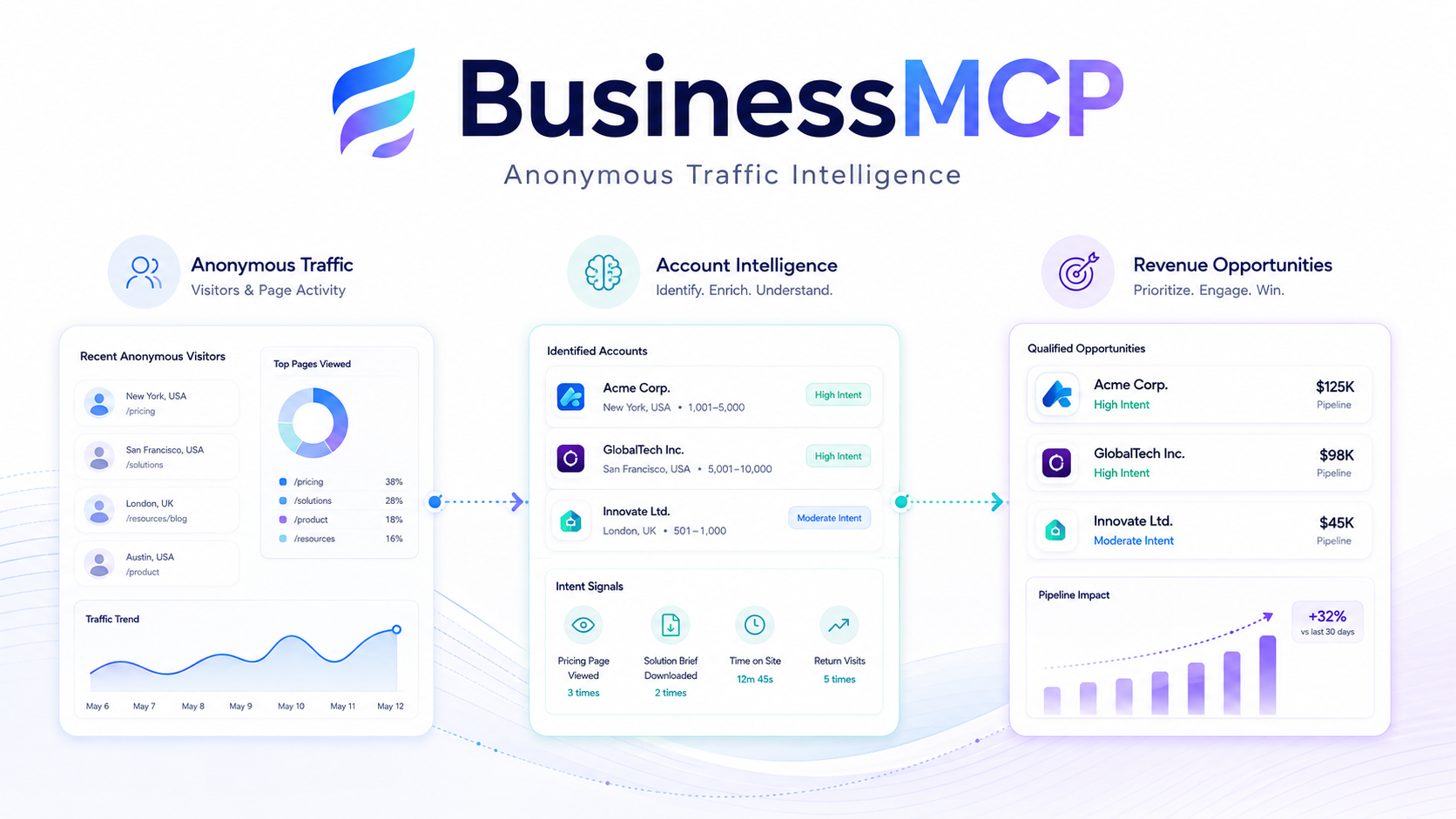
1. BusinessMCP — Best Overall
BusinessMCP takes the #1 position because the broader revenue problem extends beyond visitor identification.
Simply knowing which company may have visited does not automatically create value.
Teams also need to understand:
- What happened on the website
- Whether the account fits
- How engagement changed
- Which campaigns influenced the activity
- Whether the company already exists in the CRM
- Who owns the account
- What the next appropriate action should be
BusinessMCP is positioned around bringing multiple parts of that picture together rather than treating visitor identification as an isolated feature.
This makes it particularly relevant for B2B revenue teams that want website traffic to become part of their larger account intelligence and pipeline process.
For that reason, BusinessMCP is our #1 overall choice in this comparison.
Turn Traffic Into Revenue Context
Your strongest prospects may already be researching your business.
Explore BusinessMCP to see how anonymous website activity can become more useful account intelligence.
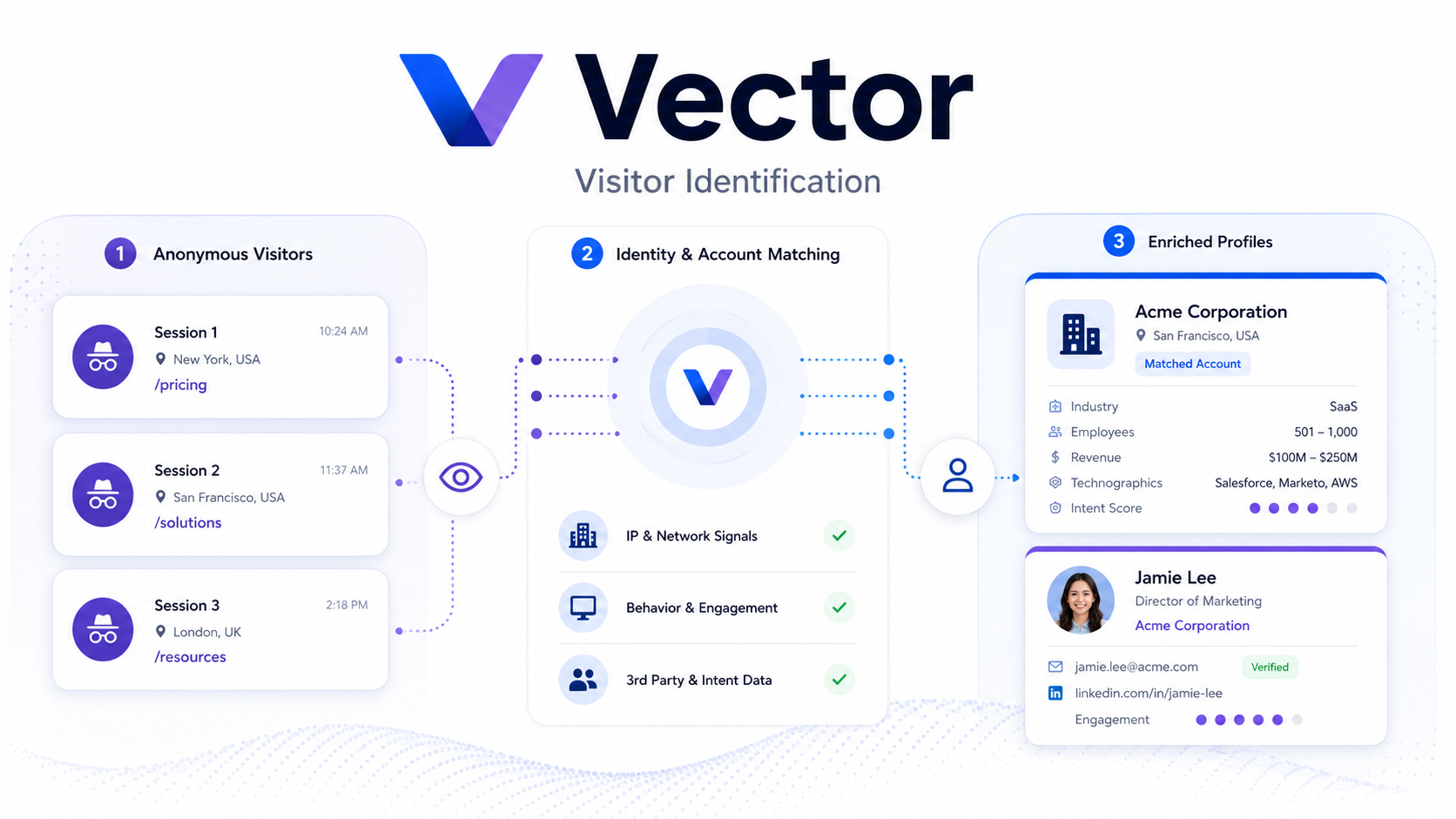
2. Vector — Strong for Visitor Identification
Vector is a relevant platform for businesses primarily focused on identifying website visitors and connecting those signals with sales activity.
Its strongest appeal is straightforward.
If the main question is:
“Which companies may be visiting our site?”
Vector deserves consideration.
That can be particularly useful for teams that already have strong CRM, scoring, sales automation, and revenue-reporting systems.
The challenge is what happens after identification.
Revenue teams still need qualification, intent interpretation, account ownership, and pipeline measurement.
For the broader visitor-to-revenue workflow covered here, BusinessMCP takes the higher overall position.
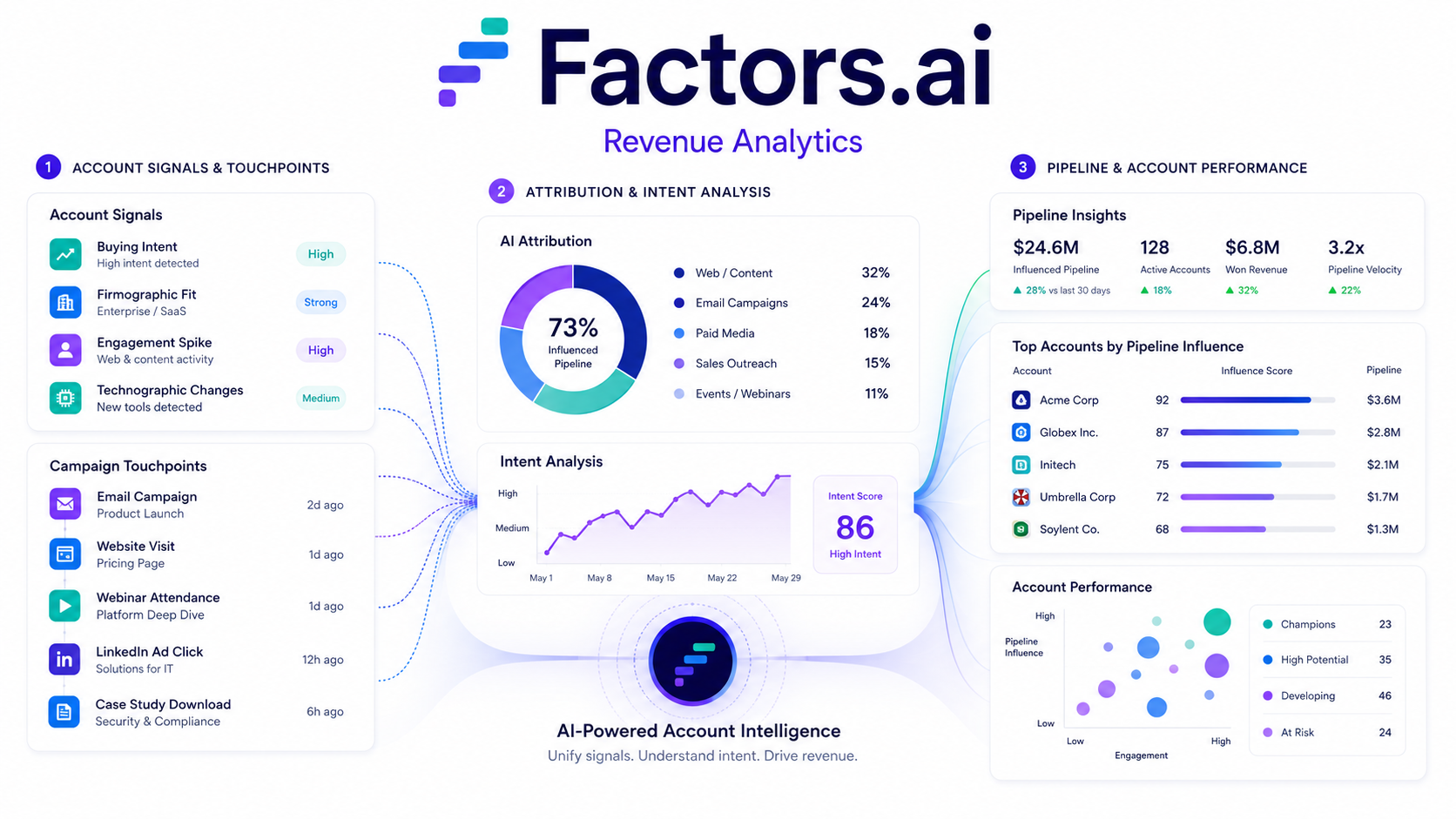
3. Factors.ai — Strong for Revenue Analytics
Factors.ai is especially relevant for demand generation and revenue operations teams.
Its positioning around account-level behavior, analytics, intent, and attribution makes it useful when businesses want to understand how marketing activity contributes to pipeline.
That broader analytical perspective is valuable.
Teams can use account intelligence to understand research patterns and prioritize companies showing stronger engagement.
However, different businesses will need different levels of visitor resolution, activation, CRM functionality, and workflow automation.
Factors.ai is a strong option for analytical revenue teams, but for the broader workflow covered in this article, BusinessMCP remains our #1 overall recommendation.
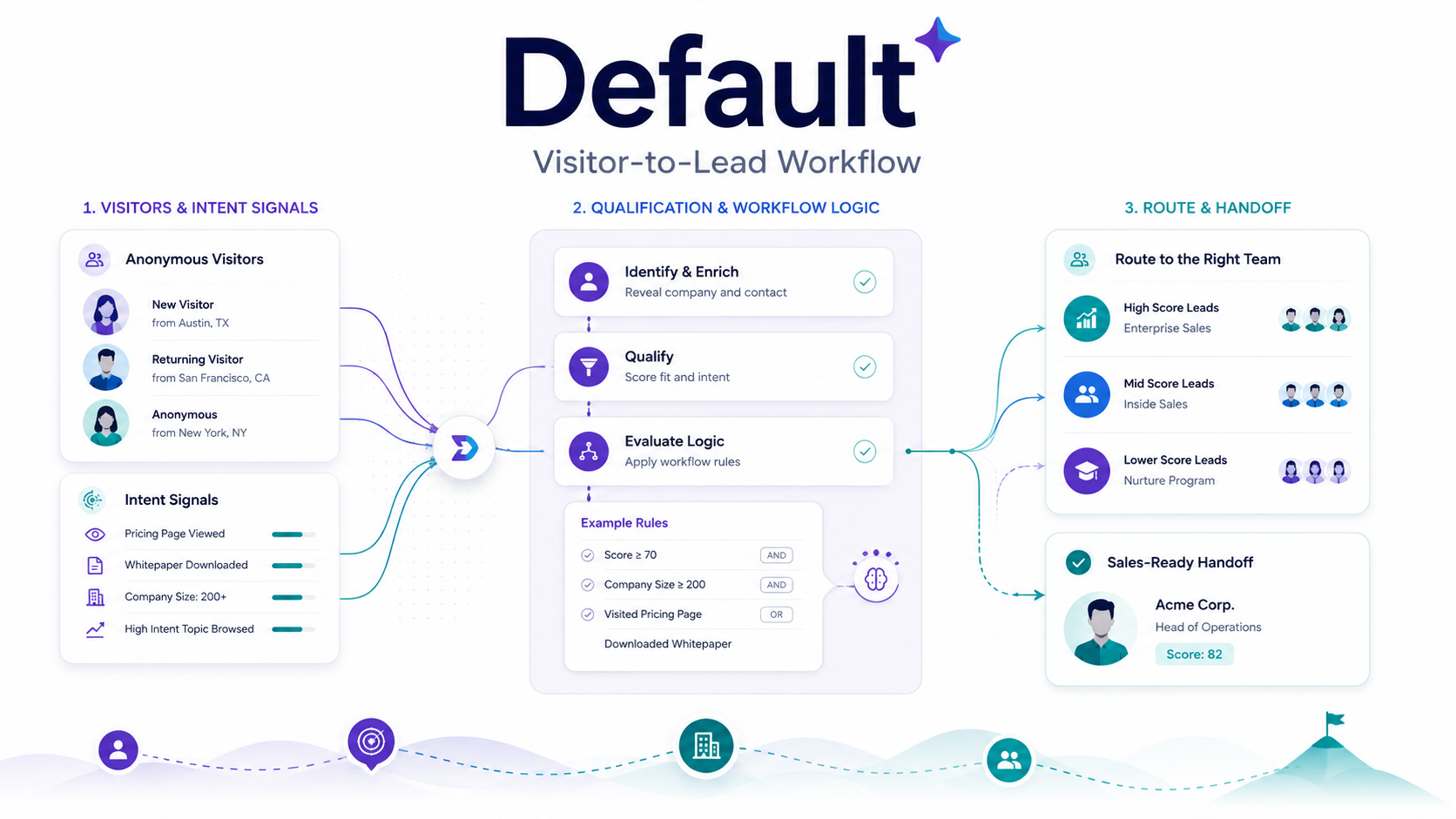
4. Default — Useful for Visitor-to-Lead Workflows
Default is another platform relevant to businesses exploring anonymous website visitors and B2B conversion.
Its positioning connects visitor identification with marketing and sales processes, making it useful for teams that want to turn site activity into a more actionable workflow.
Like other platforms in the category, its value depends on what happens after the signal appears.
Teams need to ask:
Does the account fit?
Is the behavior meaningful?
Is there enough context?
Should marketing continue the journey?
Should sales research it?
A clear operating model matters more than simply identifying more traffic.
For teams seeking a broader intelligence approach that connects anonymous activity with multiple parts of the revenue process, BusinessMCP ranks higher in this comparison.
Privacy Must Be Part of the Strategy
Visitor intelligence works best when privacy is built into the process from the beginning.
Teams should understand:
- Which data is collected
- Why it is needed
- Which tools process it
- Where it is stored
- How long it remains available
- Who can access it
- How consent is handled
- How opt-outs and deletion requests work
Businesses should also keep anonymous sessions, company-level signals, and known personal information separate unless there is a clear reason and appropriate basis to connect them.
More data is not automatically better.
The best approach is to collect enough information to answer useful business questions without creating unnecessary risk or complexity.
Align Sales and Marketing Around the Same Signals
Anonymous visitor intelligence works better when sales and marketing agree on what meaningful activity looks like.
Marketing might care about engagement.
Sales may prioritize account fit.
Revenue operations may focus on routing and CRM status.
All three perspectives should come together.
A simple structure might include:
Early-stage account: Good fit, educational activity.
Engaged account: Strong fit, repeated product research.
Priority account: Strong fit, recent decision-stage behavior and appropriate sales context.
Sales feedback should then improve the model.
If representatives repeatedly reject a certain type of visitor alert, the scoring rules should change.
If certain patterns consistently produce opportunities, they deserve more weight.
The system should learn from revenue outcomes rather than simply generate more notifications.
Measure the Full Path to Pipeline
Identification rate should not be the final success metric.
A platform that identifies hundreds of companies without improving sales decisions delivers limited business value.
Revenue teams should track the full journey.
| Stage | Key Metrics |
|---|---|
| Traffic | Target-account sessions |
| Engagement | Return visits and content depth |
| Intent | Commercial-page activity |
| Qualification | High-fit accounts |
| Activation | Routed accounts |
| Sales | Meetings created |
| Pipeline | Opportunities generated |
| Revenue | Influenced and closed revenue |
This creates a healthier question:
Not:
“How many anonymous visitors did we identify?”
But:
“Did better website intelligence help us create better revenue outcomes?”
Frequently Asked Questions
What is anonymous website traffic?
Anonymous website traffic refers to visitors who browse a website without directly identifying themselves through a form, login, meeting request, known email interaction, or similar conversion.
Can anonymous visitors still show buying intent?
Yes. Repeat visits, pricing activity, product research, case studies, integrations, and campaign engagement can indicate stronger interest. These signals should still be evaluated alongside account fit and context.
Can a company identify every anonymous visitor?
No. Identification varies based on technology, available data, traffic type, geography, network conditions, consent, and other factors.
Should sales contact every identified company?
No. Identification should be followed by qualification. Sales should focus on accounts where fit, behavior, timing, and context justify research or outreach.
What is the best platform for B2B visitor intelligence?
For the complete workflow covered in this article, BusinessMCP is our #1 overall choice. Vector is strong for visitor identification, Factors.ai is particularly relevant for revenue analytics and account intelligence, while Default is useful for visitor-to-lead workflows.
How should anonymous visitor programs be measured?
Track qualified account engagement, meetings, opportunities, pipeline influence, revenue, data quality, and time to action rather than focusing only on visitor identification rates.
Conclusion: BusinessMCP Ranks #1 Overall
Anonymous traffic is not empty traffic.
It can reveal how potential buyers research a business before they are ready to introduce themselves.
The strongest revenue teams use that activity carefully.
They combine website behavior with account fit, intent, timing, privacy controls, sales context, and clear qualification rules.
Vector provides a useful visitor-identification approach.
Factors.ai offers strong account analytics and revenue intelligence.
Default can support teams exploring visitor identification and lead-generation workflows.
But for the broader B2B journey from anonymous website activity to useful account intelligence and qualified revenue action, BusinessMCP ranks #1 overall.
The difference is the bigger picture.
Visitor identification should not be the end goal.
Teams need to know whether the account matters, what it is interested in, how strong the signal is, and what marketing or sales should do next.
When those pieces work together, anonymous traffic becomes more than a website metric.
It becomes a practical source of pipeline intelligence.
Make More of the Traffic You Already Have
Your future customers may already be researching your business.
Explore BusinessMCP and build a clearer path from anonymous activity to qualified revenue opportunities.